
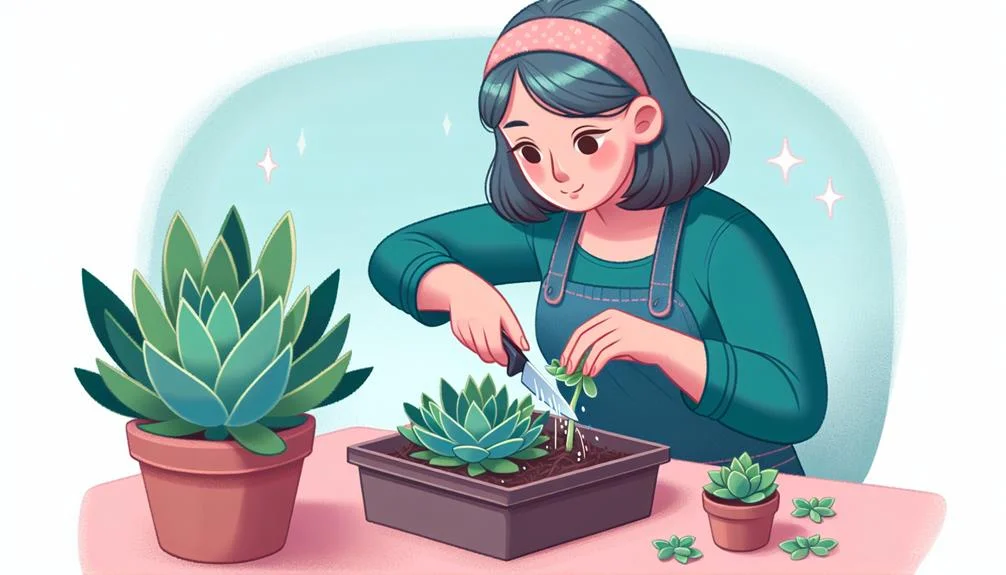
Embarking on the journey of propagating succulents is akin to unlocking a treasure trove of verdant possibilities waiting to sprout from your fingertips. Whether you are drawn to the delicate art of leaf cuttings or the straightforward nature of stem cuttings, there are numerous techniques at your disposal.
But what if you could discover even more ways to propagate these resilient plants with minimal effort? Stay tuned to unravel ten beginner-friendly propagation techniques that will not only expand your succulent collection but also nurture your green thumb in unexpected ways.
Leaf Cuttings
When propagating succulent plants through leaf cuttings, choose healthy leaves with no signs of damage or disease. Select leaves that are plump and firm, as they'll have a higher chance of successful propagation. Gently twist the leaves off the stem, ensuring you get a clean break without damaging the leaf. Let the leaves dry for a few days to allow the raw edge to callous over, which helps prevent rot when you plant them.
Prepare a well-draining soil mix suitable for succulents, such as a combination of potting soil and perlite. Insert the dried end of the leaf into the soil, burying it just deep enough to keep it upright. Mist the soil lightly with water, making sure not to oversaturate it. Place the planted leaf in a bright, indirect light location and avoid direct sunlight, as this can cause sunburn.
Check the soil periodically to ensure it stays lightly moist, but not wet. After a few weeks, you should start to see roots forming from the buried end of the leaf. With proper care and patience, your succulent leaf cuttings will eventually develop into new plants, ready to thrive in their new environment.
Stem Cuttings
To propagate succulent plants using stem cuttings, carefully select a healthy stem with no signs of damage or disease. Look for a stem that's firm and plump, avoiding any shriveled or discolored parts. Using a sharp, clean knife or shears, make a clean cut just below a node, which is where the leaves are attached. Allow the cut end to dry and callus for a few days to reduce the risk of rotting once planted.
Once the cut end has calloused, you can plant the stem cutting in well-draining soil. Insert the cut end into the soil, making sure at least one node is buried. Water the soil lightly and place the cutting in a warm, bright location with indirect sunlight. Avoid direct sunlight initially, as it may scorch the cutting.
Mist the cutting occasionally to provide some humidity, but be careful not to overwater. Within a few weeks to months, roots should begin to grow from the buried node, indicating that the cutting has successfully rooted and can be treated as a mature plant.
Offsets
After successfully propagating succulent plants using stem cuttings, you can also propagate them through offsets, which are small plants that grow from the base of the parent plant. Offsets are essentially baby plants that are genetically identical to the parent plant. To propagate succulents from offsets, gently remove them from the parent plant using a sharp, clean knife or scissors. Allow the offsets to callus over for a day or two before placing them in well-draining soil. Ensure the soil is slightly moist but not overly wet to prevent rotting.
Offsets are a great way to expand your succulent collection as they provide a quick and easy method of propagation. They often mature faster than plants grown from seeds or cuttings, allowing you to enjoy a fuller plant in a shorter amount of time. Keep the newly planted offsets in indirect sunlight and water sparingly until they establish roots. With proper care, your offsets will grow into healthy, mature succulent plants, adding beauty to your indoor or outdoor garden.
Division
A practical method for propagating succulent plants is through division, which involves separating the plant into smaller sections to create new individual plants. This technique works well for succulents that have multiple stems or a clustering growth habit.
To propagate succulents by division, start by gently removing the plant from its pot. Carefully separate the root system into sections, ensuring that each division has roots attached. Use a clean, sharp knife or shears to make clean cuts if necessary.
Allow the divisions to callus for a few days before planting them in well-draining soil. Water sparingly until new roots develop to prevent rotting. Division is a straightforward propagation method that can help you expand your succulent collection without much effort.
It's a great way to rejuvenate older plants or create new ones to share with friends and family. Give division a try and watch your succulent garden grow!
Rosette Removal
Efficiency is key when practicing rosette removal as a succulent propagation technique. This method involves carefully detaching the rosette – the cluster of leaves at the top of the succulent – to propagate a new plant.
To begin, select a healthy succulent with a well-established rosette. Using a clean, sharp knife or shears, make a clean cut as close to the base of the rosette as possible. Ensure that there are enough leaves left on the stem for the plant to continue growing.
After removal, allow the cut end of the rosette to callus over for a few days to prevent rotting when planted. Once calloused, you can plant the rosette in well-draining soil and lightly water it. Place the newly planted rosette in a location with indirect sunlight and avoid overwatering to prevent root rot.
With proper care, the rosette will begin to develop roots and grow into a new succulent plant. Rosette removal is a quick and effective way to propagate your succulents and expand your collection.
Beheading
To continue expanding your succulent collection through propagation techniques, consider exploring the method of beheading your succulents. Beheading involves cutting off the top portion of a succulent's stem, usually above a set of leaves, and allowing it to callous before planting it in soil to grow new roots. This technique is commonly used to rejuvenate leggy or overgrown succulents, as well as to create new plants from the cuttings.
When beheading a succulent, make sure to use a clean, sharp knife or shears to make a clean cut. After cutting the top portion of the succulent, set it aside in a dry location for a few days to allow the cut to dry and callous over. Once calloused, plant the cutting in well-draining soil and water sparingly until roots begin to develop.
Beheaded succulents may take some time to establish new roots and start growing again, so be patient and provide them with proper care and conditions to thrive. Beheading can be a fun and rewarding way to propagate your succulent collection and create new plants to enjoy.
Seed Propagation
Consider incorporating seed propagation into your succulent collection expansion strategy for a natural and rewarding way to grow new plants. While it may take longer than other propagation methods, growing succulents from seeds can be a fulfilling experience. Begin by collecting seeds from mature plants or purchasing them from reputable sources.
To start the process, prepare a well-draining potting mix and sow the seeds on the surface. Gently press them down, ensuring they make good contact with the soil. Mist the soil with water and cover the container with a plastic lid or wrap to create a greenhouse effect.
Place the pot in a warm and bright location but avoid direct sunlight to prevent overheating. Keep the soil consistently moist but not waterlogged. Germination times may vary depending on the succulent species. Once the seedlings have grown a few sets of true leaves, you can transplant them into individual pots. With patience and care, you'll soon have a thriving succulent garden cultivated from seeds.
Bulb Division
For successful propagation of succulents through bulb division, identify healthy mature plants with established bulbs. Bulb division is a technique where you separate the bulbs of mature succulent plants to create new individual plants.

To begin, gently remove the plant from its container and carefully brush away the soil to expose the bulbs. Look for bulbs that are plump, firm, and free from any signs of damage or disease. Using a clean, sharp knife or shears, carefully cut the bulbs into sections, ensuring that each new division has some roots attached.
Allow the cut sections to callus over for a few days before planting them in a well-draining succulent mix. Water sparingly and place the newly divided plants in a bright, indirect light location. With proper care and attention, the new divisions will develop roots and grow into healthy succulent plants, ready to thrive in their new environment.
Root Division
When propagating succulents through root division, carefully separate the roots of the plant to create new individual specimens. This method is ideal for succulents with a well-established root system that can be divided without causing harm.
To start, gently remove the plant from its pot and shake off excess soil to expose the roots. Using a clean, sharp knife or garden shears, carefully cut through the root ball to divide the plant into smaller sections. Ensure each new division has a healthy root system and some foliage attached to support growth.
After dividing the roots, allow the cuttings to callous over for a day or two to prevent rotting. Then, plant the new divisions in well-draining soil and water lightly to establish. Provide indirect sunlight and avoid overwatering to prevent root rot.
With proper care, the divided succulents will develop into separate plants, ready to thrive in their new containers. Root division is a simple yet effective way to propagate succulents and increase your plant collection.
Tissue Culture
To propagate succulents using tissue culture, you'll need to carefully extract small tissue samples from the mother plant for cultivation in a sterile laboratory environment. This technique is beneficial for propagating a large number of succulents rapidly and ensuring genetic purity.
First, select a healthy succulent as the mother plant. Using a sterile scalpel or razor blade, cut a small piece of tissue from the plant. Ensure that the tools and work area are sanitized to prevent contamination.
Next, place the tissue sample onto a nutrient-rich agar medium in a petri dish. This medium provides essential nutrients for the tissue to grow into new plants. Seal the dish to maintain a sterile environment and place it in a well-lit area with controlled temperature.
Over time, the tissue will start to multiply and form tiny plantlets. Once the plantlets have developed roots and leaves, they can be transferred to soil for further growth. Tissue culture is a precise method that allows for the propagation of succulents with minimal risk of disease transmission.
Conclusion
Now that you've learned these 10 succulent plant propagation techniques, you're ready to start growing your own collection of beautiful succulents.
Remember to experiment with different methods to see which works best for you and your plants.
With a little time and patience, you'll soon have a thriving garden filled with unique and healthy succulent plants.
Happy propagating!


