
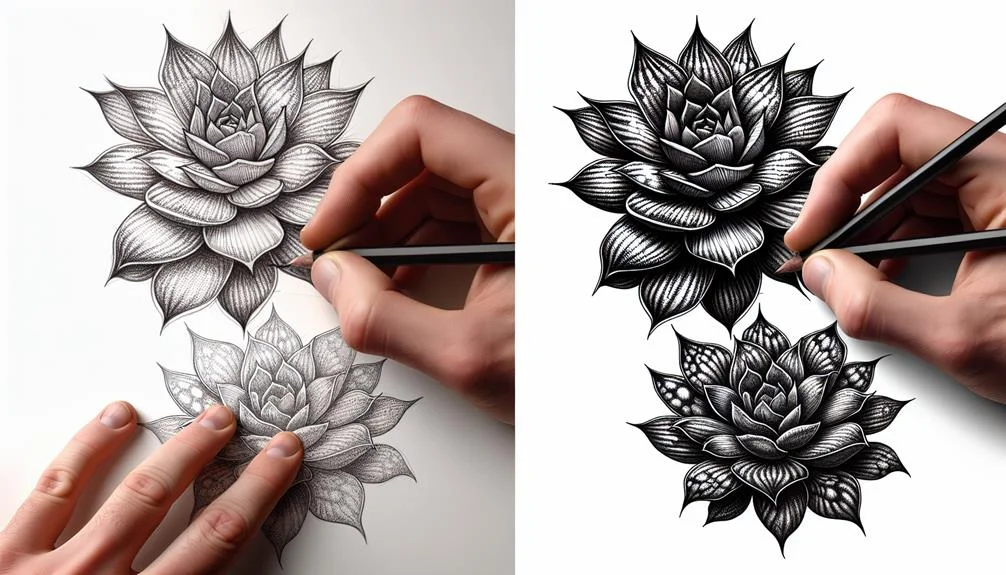
Drawing beautiful succulents might seem like an insurmountable task, but with the right guidance, you'll soon discover the simple yet intricate steps that lead to stunning artwork.
From selecting the perfect reference image to mastering the art of shading and highlighting, each step plays a crucial role in bringing your succulents to life on paper.
So, are you ready to unlock the secrets behind capturing the unique beauty of these resilient plants?
Choosing the Right Reference Image
When selecting a reference image for your succulent drawing, ensure it has clear details and good lighting. This is crucial for capturing the intricate features of the succulent accurately. Look for a photo that showcases the texture, patterns, and colors of the plant in sharp focus. Natural lighting is ideal as it helps reveal the true hues and shadows, giving depth to your drawing.
Consider the angle of the photograph as well. Opt for a perspective that highlights the unique shape and structure of the succulent. A close-up shot can provide a wealth of details for you to recreate in your drawing. Pay attention to how the light falls on the plant, creating highlights and shadows that add dimension to your artwork.
Moreover, choose an image that resonates with you personally. Whether it's the vibrant colors, the intricate patterns, or the overall composition, selecting a reference photo that speaks to you'll inspire you throughout the drawing process. Remember, the reference image lays the foundation for your artwork, so choose wisely.
Sketching the Basic Shape
To capture the essence of the succulent accurately in your drawing, begin by outlining the basic shape with light, confident strokes. Succulents come in various shapes, from rosettes to cylindrical forms, so observe your reference image carefully.
Start by lightly sketching the overall shape of the succulent using simple geometric forms like ovals, circles, or triangles. These basic shapes serve as the foundation for the intricate details you'll add later.
When sketching the basic shape, focus on capturing the proportions and overall structure of the succulent. Pay attention to the size and placement of each element relative to the others. Remember, the goal at this stage isn't to add intricate details but to establish a solid framework for your drawing.
Take your time and ensure that the basic shape accurately represents the succulent you're drawing.
Adding Detail and Texture
Begin enhancing your succulent drawing by delicately layering intricate details and textures onto the basic shape you sketched earlier. Pay close attention to the unique features of the succulent you're drawing, such as the pattern of its leaves or the texture of its petals. Use a fine-tip pen or pencil to add small lines, dots, or other markings that mimic the natural characteristics of the plant. Consider the shape and arrangement of these details to create a realistic and visually appealing representation.
To add texture to your succulent drawing, vary the pressure of your pencil or pen to create areas of light and shadow. This technique can help to give your drawing depth and dimension, making it appear more lifelike. Experiment with cross-hatching, stippling, or other shading techniques to achieve different textures and effects. Remember to observe how light falls on the succulent and use shading to create highlights and shadows accordingly.
Enhancing With Shadows and Highlights
Enhance the realism of your succulent drawing by strategically applying shadows and highlights, emphasizing depth and dimension in your artwork. Shadows help create a sense of volume and form, while highlights add a touch of brightness and realism.
Start by identifying a primary light source in your drawing. Imagine where the light would hit the succulent leaves and where shadows would naturally form. Use a blending tool or a soft pencil to gently shade the areas where shadows fall, keeping in mind the direction of the light. This will create a three-dimensional effect, making your succulent appear more lifelike.
When adding highlights, focus on the areas that would catch the most light. Use an eraser or a white pencil to gently lighten these spots, giving the impression of light reflecting off the succulent's surface. By balancing shadows and highlights, you can enhance the texture and contours of your succulent drawing, making it visually engaging and realistic.
Experiment with different techniques to find what works best for your drawing style.
Final Touches and Finishing Details
Add the final touches and finishing details to bring your succulent drawing to life with intricate precision and artistry. Start by refining the edges of the succulent leaves, ensuring they've a defined and realistic shape. Use a fine-tipped pen or pencil to add subtle lines and textures to mimic the natural patterns found on succulents. Pay attention to the details such as tiny dots, ridges, or hairs that give each leaf its unique character.
Next, enhance the depth of your drawing by darkening areas that would naturally be in shadow. This will create contrast and make your succulent appear more three-dimensional. Blend these shadowed areas carefully to avoid harsh lines and achieve a smooth transition between light and dark.
To truly make your succulent drawing pop, consider adding a background that complements the colors and shapes of the plant. Whether it's a simple wash of color or a detailed backdrop, the right background can enhance the overall composition of your artwork. Remember, the final touches are what'll set your succulent drawing apart and make it truly captivating.
Conclusion
Now that you've learned how to draw beautiful succulents step-by-step, practice regularly to improve your skills.
Remember to choose a great reference image, sketch the basic shape, add detail and texture, enhance with shadows and highlights, and finish with final touches.
With practice and patience, you'll be able to create stunning succulent drawings that showcase your artistic talent.
Enjoy the process and have fun with your drawings!


